The boring shaft of a boring machine is the core component of the entire machine tool, which is composed of a boring shaft and a milling shaft. The boring shaft relies on two guide keys to move forward and backward axially, achieving tool feed. At the same time, the milling shaft rotates through key transmission. The milling shaft relies on the positioning of the front and rear bearings, which are installed in the spindle box and directly receive transmission power to drive the boring shaft to rotate and work. Based on the actual situation, analyze the precision grinding and grinding processes of the boring shaft machining process.
1. Process analysis of boring shaft
The material and blank of the boring shaft (see attached figure) are 38CrMoAlE high-quality alloy structural steel bars, with specifications of φ 140mm × 2 250mm (including test pieces). The straightness of the (17 ± 0.1) mm keyway is 0.03mm; The parallelism tolerance of the two keyways is 0.03mm; The scale tolerance of both sides of the keyway is 0.02mm; The straightness tolerance of the boring shaft is 0.01mm, and the surface roughness value Ra=0.1 μ m。 To ensure that the assembly of the milling shaft and bushing meets the requirements, the roundness tolerance of the boring shaft is ≤ 0.005mm, and the taper tolerance is ≤ 0.005mm. Nitriding treatment of boring shaft: D0.5-900.

Figure of boring shaft
2. Machining process of boring shaft
The processing process is as follows: cutting → normalizing → rough turning → tempering → correcting the center hole → semi precision turning → cutting the test piece → marking → milling the keyway → rough grinding the conical hole → semi precision milling the keyway → fitter → grinding the keyway (with grinding allowance) → semi precision grinding the outer circle → nitriding → repairing the center hole → precision grinding the conical hole → semi precision grinding the outer circle → precision grinding the keyway → precision grinding the outer circle.
Refine the outer circle. The precision grinding process of the outer circle of the boring shaft is carried out on the HG-92-5000-B11 CNC grinding machine, and the outer circle is required φ 110h6. The method used for precision grinding of the outer circle of our factory's spindle is the center grinding method with longitudinal cutting. The grinding wheel performs the main cutting motion, and the workpiece rotates (circumferential cutting) and performs linear reciprocating motion (longitudinal cutting) with the workbench. The grinding allowance is removed through multiple longitudinal cutting passes. At the end of each reciprocating stroke, the grinding wheel laterally cuts in and feeds in.
When using the center grinding method, attention should be paid to: ① When grinding, the reference center hole should be ensured to be accurate. If the shaft needs to undergo heat treatment, the center hole should be corrected before grinding. ② The selection of grinding wheels should be correct, otherwise it will affect the surface roughness, and the quality of dressing the grinding wheel will directly affect the surface quality after processing. Therefore, the grinding wheel should be corrected promptly and carefully During the machining process, it is necessary to pay attention to sufficient cooling and choose appropriate cutting fluid Try to use the turning device on all surfaces of the grinding shaft in one installation to avoid errors caused by multiple installations. ⑤ When grinding a long shaft, a center frame should be used. ⑥ When conditions permit, it is best to use an automatic measuring device that checks the size of the workpiece during processing without stopping, in order to reduce auxiliary time and improve production efficiency. During precision grinding, the main process factors that affect the surface quality of grinding should be well grasped, such as the characteristics of the grinding wheel, grinding amount, lubrication and cooling, correction of the grinding wheel, and vibration during processing.
For example, the particle size of a grinding wheel has a significant impact on surface roughness. The coarser the abrasive particles, the poorer the surface quality after processing, but the particle size should not be too fine. Otherwise, a large amount of heat will be generated on the surface of the workpiece during processing, which will actually lead to a decrease in surface quality. The general abrasive particle size should be between 60 # and 80 #. For precision grinding, the optional particle size is 120 #. Our factory uses alumina medium soft grinding wheels with a particle size of 60 # for precision grinding.
At the same time, the circumferential speed of the grinding wheel also has a significant impact on the surface roughness of the workpiece. If other conditions remain unchanged and the grinding wheel speed is increased, the number of abrasive particles participating in cutting within a single piece of time increases, the burden on each particle is reduced, the cutting force decreases, and the surface quality of the workpiece improves. If the grinding wheel speed is increased while the workpiece speed is correspondingly increased, the surface quality of the workpiece can also be improved, and productivity can also be increased. But for parts like the spindle, the rotational speed should not be too high, as an increase in rotational speed may result in out of tolerance roundness.
The cutting parameters used for precision grinding of the outer circle of the spindle are: cutting depth t1=0.03mm, t2=0.01mm, t3=0.002-0.005mm, t4=0.00mm; The workpiece speed is 20-28r/min; The grinding wheel speed is 1450r/min.
The geometric accuracy achieved after grinding meets the requirements of the drawing, with roundness ≤ 0.005mm; Surface roughness value Ra=0.8 μ m; Full length bending vibration ≤ 0.01mm.
However, during precision grinding, a concave surface will appear at the end of the keyway at the front end of the boring shaft, which creates certain difficulties for the grinding process. In addition, after precision grinding, remove the grinding center and replace it with a dedicated grinding center during grinding. Therefore, when removing the precision grinding spindle, one end of the boring shaft cone hole will deform, causing another grinding, especially the roundness tolerance will be more difficult to achieve.
Grind the outer circle. Grinding the outer circle is the final finishing process of the boring shaft. Grinding can achieve high dimensional accuracy and surface quality, while grinding parts such as boring shafts is not affected by keyways, which can eliminate the cumbersome process of keying. However, the machining allowance in the grinding process is very small, so the surface to be machined should ensure high dimensional accuracy and surface quality before grinding.
Before grinding the boring shaft in our factory, the following requirements are required: ① The dimensional tolerance should generally reach the upper deviation, and the outer circle size of the boring shaft should be finely ground to φ 110mm。② The roundness and taper tolerances of the parts are ≤ 0.005mm. ③ Before grinding, the straightness of the entire length of the part meets the requirements of the drawing, and the grinding itself cannot? Straightness of positive parts. ④ The surface roughness value before grinding must reach Ra=0.8 μ Above m.
The equipment used for boring and grinding in our factory is a horizontal lathe. The spindle used for grinding tools is similar to the semi precision grinding process for outer circles. The material of a general grinding tool should be softer than the material of the workpiece, with a uniform structure. Only by having a uniform structure of the grinding tool can the uniformity of the grinding workpiece be ensured. The grinding tool must also have good wear resistance, and the size and geometric shape of the grinding tool itself directly affect the accuracy of the size and geometric shape of the workpiece after grinding. If the grinding tool is too hard, although it can maintain its own accuracy, the abrasive is not easily embedded on the surface of the grinding tool. During grinding, the abrasive rolls or slides between the grinding tool and the workpiece surface. Although this also has a cutting effect, the efficiency is low and the abrasive is easily squeezed out of the grinding tool and workpiece surface. The most unfavorable situation is that when grinding softer workpieces, the abrasive may be embedded on the workpiece surface and deteriorate the surface quality; On the contrary, if the grinding tool is too soft, wears quickly and unevenly, it is easy to lose its correct geometric shape accuracy and affect the grinding quality.
The most commonly used is cast iron grinding tools, which are suitable for processing various workpiece materials and precision grinding, ensuring good grinding quality and high production efficiency. Moreover, the manufacturing of grinding tools is easy and the cost is also low. Grinding tools made of copper, aluminum, and other materials are suitable for rough grinding with large removal allowances.
During the grinding process, the grinding fluid not only plays a role in blending abrasives and lubricating cooling, but also plays a chemical role to accelerate the grinding process. For example, adding viscous oleic acid to the grinding fluid will adhere to the surface of the workpiece, causing a layer of oxide film to quickly form on the surface of the workpiece. At the beginning of grinding, the protruding oxide film on the surface of the workpiece has a small contact surface with the grinding tool, and the pressure per unit area is high. It is first scraped off by the abrasive particles, and the new metal surface is quickly oxidized again. The newly formed oxide film is also easily scraped off. As this continues, the convex peaks are gradually smoothed out; The oxide film on the concave surface of the workpiece serves as a protective layer, preventing further oxidation of the concave area. Grinding fluid is generally used with kerosene or gasoline, and strong oxidizing oleic acid, fatty acid, stearic acid, or industrial glycerol are added. When grinding the boring shaft, all grinding agents are a mixture of white alumina powder and kerosene, without adding acid or industrial glycerol.
3. Conclusion
After grinding, the boring shaft can achieve high accuracy and surface quality. The outer circle size meets the requirements of the drawing, and the surface roughness value reaches Ra=0.1 μ Above m; Both taper and roundness ≤ 0.005mm. Through actual machining verification, the use of precision grinding and grinding can ensure the design requirements of the boring shaft.
More about WBM Spherical Roller:
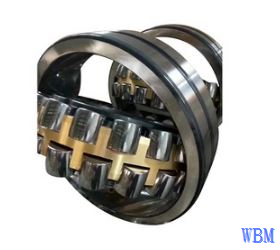
Spherical roller bearings have two rows of symmetrical rollers, a common sphere outer ring raceway and two inner ring raceways inclined at an angle to the bearing axis. The centre point of the sphere in the outer ring raceway is at the bearing axis.
https://www.bearingroller.com/rolling-elements/taper-roller/spherical-2roller.html